
Body Jewellery Size Guide
Choosing the right size of body jewellery can make a big difference to how comfortable it feels and how it looks when worn. Whether you’re replacing a favourite piece or trying a different style, understanding jewellery measurements can help you make the right choice.
Different piercings require different jewellery thicknesses, lengths and diameters. Even two piercings in the same position may need different sizes, so it’s important to choose jewellery that suits your individual piercing.
This guide explains how body jewellery is measured and provides common sizes for a wide range of piercings.
How to measure your body jewellery
Our illustrated measurement chart shows exactly where to measure different jewellery styles, including straight and curved barbells, belly bars, nose studs, labrets, rings, plugs and tunnels.
If you’re replacing existing jewellery, checking its measurements is often the easiest way to find the right size.
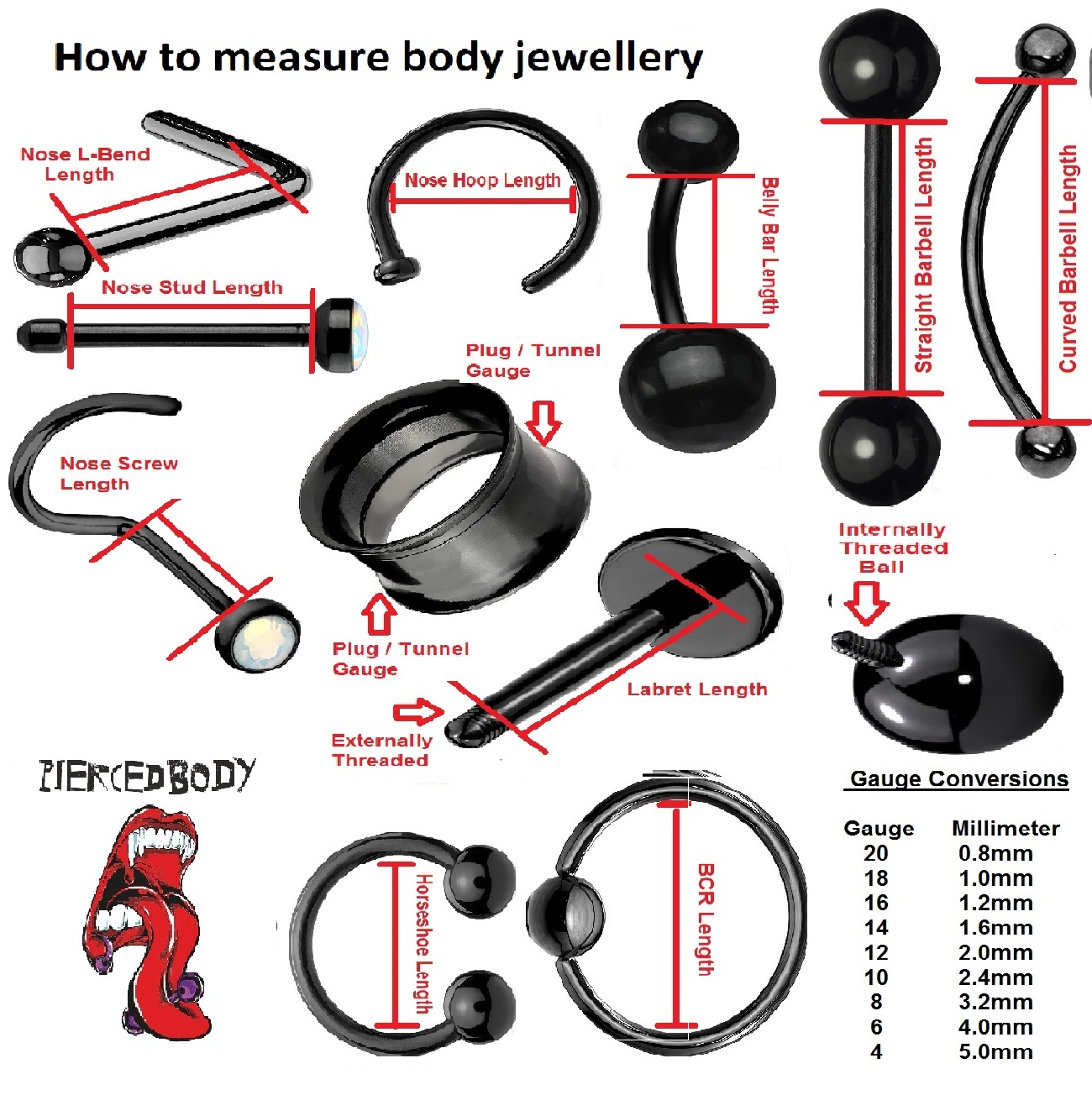
Click the chart to view the full-size image.
Understanding jewellery measurements
Bar thickness (gauge)
This refers to the thickness of the bar that passes through your piercing. For example, 1.2mm is commonly known as 16 gauge (16g), while 1.6mm is 14 gauge (14g).
Bar length
This is the wearable length of a straight or curved bar, measured between the end fittings rather than including the balls or decorative ends.
Ring diameter
This is the internal diameter of a ring, measured across the inside of the jewellery.
Common gauge conversions
| Gauge | Thickness |
|---|---|
| 20g | 0.8mm |
| 18g | 1.0mm |
| 16g | 1.2mm |
| 14g | 1.6mm |
| 12g | 2.0mm |
| 10g | 2.4mm |
| 8g | 3.2mm |
| 6g | 4.0mm |
| 4g | 5.0mm |
Before choosing your size
The measurements in this guide are commonly used sizes and should be treated as a guide rather than an exact recommendation.
The correct fit depends on your individual piercing.
If your piercing is new, irritated or still healing, we recommend asking your professional piercer for advice before changing your jewellery.
Common jewellery sizes by piercing type
Belly Piercings
Bar thickness: 1.6mm (14g)
Typical bar length: 10mm–11mm
Most belly piercings use a curved barbell measuring 10mm or 11mm. A shorter 6mm or 8mm bar may suit a shallower piercing, while a longer 12mm or 14mm bar may be needed for a deeper piercing. The correct fit depends on your individual piercing, and the jewellery should sit comfortably without excessive pressure or movement.
Daith Piercings
Bar thickness: 1.2mm (16g)
Typical ring diameter: 8mm–10mm
Daith piercings commonly use circular jewellery such as captive bead rings or horseshoe barbells. The diameter you need depends on the position of your piercing and how you prefer the jewellery to sit.
Eyebrow Piercings
Bar thickness: 1.2mm (16g)
Typical bar length: 8mm
Curved barbells are commonly used for eyebrow piercings. A longer bar may be fitted initially to allow for swelling. Once healing has progressed, a shorter bar may provide a more comfortable fit. Your professional piercer can advise when downsizing is appropriate.
Helix & Tragus Piercings
Bar thickness: 1.2mm (16g)
Typical bar length: 6mm–8mm
Flat-back labret studs and cartilage barbells are popular choices for helix and tragus piercings. Flat-back labrets have a smooth disc at the back, while traditional barbells have a removable end. The most suitable length depends on the position of your piercing.
Industrial Piercings
Bar thickness: 1.6mm (14g)
Typical bar length: 30mm–38mm
Industrial piercings generally use a long straight barbell connecting two piercing holes. The length required varies according to the distance and angle between the piercings, so measuring your existing jewellery is particularly helpful.
Labret Piercings
Bar thickness: 1.2mm (16g)
Typical bar length: 6mm–10mm
Labret piercings commonly use flat-back studs. The correct length depends on the position of the piercing and how comfortably the jewellery sits against the lip.
Medusa Piercings
Bar thickness: 1.2mm (16g)
Typical bar length: 6mm–10mm
Medusa piercings are positioned above the upper lip and commonly use flat-back labret jewellery. The bar should provide a comfortable fit without pressing too tightly against the surrounding tissue.
Nipple Piercings
Bar thickness: 1.6mm (14g)
Typical bar length for men: 8mm–12mm
Typical bar length for women: 10mm–19mm
Nipple piercings are commonly fitted with straight barbells. These measurements are general guidelines, and the correct length depends on your individual piercing and how comfortably the jewellery fits.
A longer bar may be needed during initial healing to accommodate swelling. Once the piercing has healed sufficiently, your professional piercer can advise whether a shorter bar would be more suitable.
Nose Piercings
Typical thickness: 0.8mm (20g) or 1.0mm (18g)
Typical stud length: 6mm
Typical ring diameter: 8mm
Nose jewellery is available in several styles, including straight studs, L-bends, nose screws and hoops. The best length or diameter depends on the position of your piercing and the style of jewellery you prefer.
Rook Piercings
Bar thickness: 1.2mm (16g)
Typical bar length: 6mm–8mm
Rook piercings commonly use curved barbells. The correct length depends on the position of the piercing and how comfortably the jewellery sits.
Septum Piercings
Bar thickness: 1.2mm (16g)
Typical ring diameter: 8mm–10mm
Septum piercings are often worn with horseshoe barbells or rings. An 8mm diameter may provide a closer fit, while a 10mm diameter generally allows the jewellery to hang slightly lower. If you intend to flip a horseshoe barbell upwards, check that its size and shape allow this comfortably.
Smiley Piercings
Bar thickness: 1.2mm (16g)
Typical ring diameter: 8mm–10mm
Smiley piercings are commonly worn with small circular barbells or rings. The appropriate diameter depends on the placement of your piercing and how prominently you would like the jewellery to sit. Because this is a delicate area, seek advice from a professional piercer before changing jewellery.
Snake Bites Piercings
Bar thickness: 1.2mm (16g)
Typical bar length: 8mm–10mm
Snake bites consist of two separate lip piercings, usually positioned on either side of the lower lip. Flat-back labrets are commonly used. Longer bars may be needed during initial healing, with a professional piercer advising when shorter jewellery is appropriate.
Tongue Piercings
Bar thickness: 1.6mm (14g)
Typical bar length: 10mm–16mm
Most tongue piercings use straight barbells. Longer jewellery may be fitted initially to allow for swelling, but the correct length can change as healing progresses. Your professional piercer should advise when downsizing is appropriate to help avoid unnecessary contact with your teeth and gums.
Can’t find your piercing listed?
If your piercing isn’t covered in this guide, or you’re unsure which size to order, please contact us before purchasing. We’re always happy to discuss the available options and help you find suitable jewellery.
Remember that these measurements are a general guide. The correct fit depends on your individual piercing. If you’re uncertain, your professional piercer is best placed to check the size and fit.